room-door-design
Room Door Designs in Pakistan: Modern Wooden, Glass & Composite Material for Homes
Explore room door designs for Pakistani homes in 2026. Wooden, glass & composite door materials for bedrooms, bathrooms, kitchens & main entrances.
Room door designs in Pakistan use three main materials: wood, glass, and composite. Wood is the most durable, glass brings in light for kitchens and studies, and composite resists humidity best for bathrooms and kitchens. Every design is buildable in Pakistan with locally available wood, hardware, and finishes from Lahore, Rawalpindi, Islamabad, and beyond.
This guide covers room door designs, including wooden, glass, composite, flush, and panel styles. You’ll see what works for bedrooms, drawing rooms, kitchens, main entrances, and wash areas, along with material advice and current prices for each.
Walk into a house, and you notice the doors before you consciously register them. They’re the only transition between spaces you actually pass through. A 7-foot walnut flush door reads as a luxury detail. The same size door in hollow MDF reads as builder-grade, even in an otherwise expensive room.
Beyond the visual impact, doors affect:
Treat doors as a real design decision instead of an afterthought, and they become one of the highest-impact choices in a home project.
The door market in Pakistan has changed a lot in the past few years. Solid wood is still available, but engineered wood, glass, and composite materials have taken a growing share of new builds.
Many reliable interior designers in Rawalpindi & Islamabad are working these three material categories into most new projects. Here’s a closer look at each.
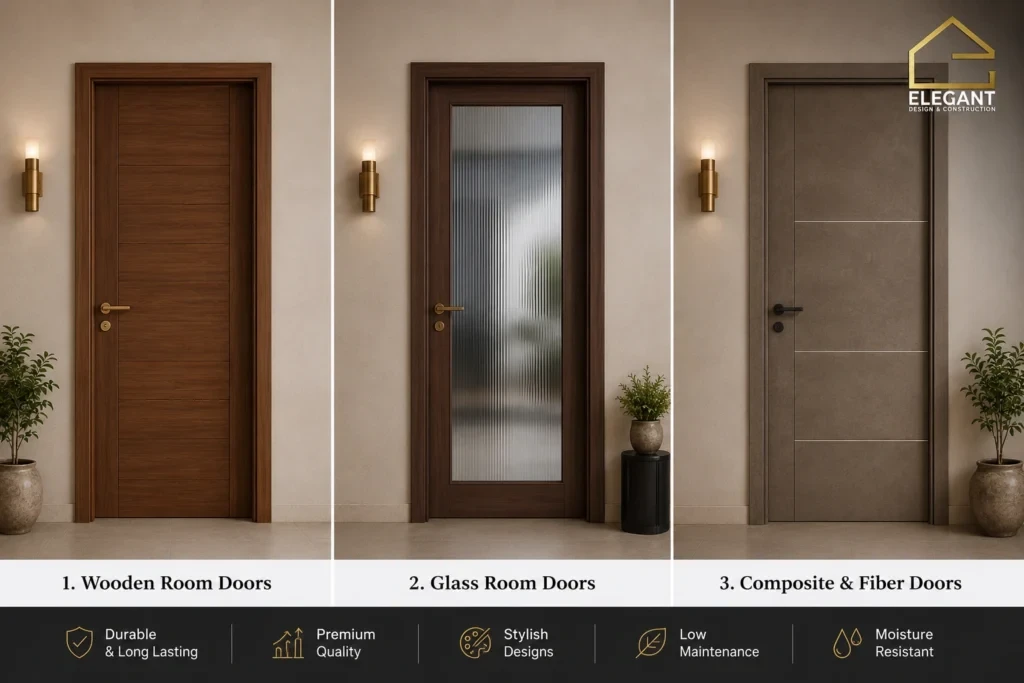
The classic choice: warm, heavy, and durable. Still the most common material for bedrooms, drawing rooms, and main entrances in Pakistani homes.
“Wooden door” actually covers very different price points:
Lifespan: 15–40 years with proper construction.
Ideal for: master bedrooms, drawing rooms, main entrances, and formal interiors.
The contemporary, light-filled alternative. Now appearing in studies, walk-in closets, pantries, and hallway transitions, beyond the usual bathroom and kitchen use.
Types of glass doors for rooms:
Lifespan: 15–25 years. Toughened glass itself holds up well; the frame hardware is what ages first.
Ideal for: kitchens, pantries, studies, powder rooms, hallways, walk-in closets.
The practical newer option. It looks like wood, handles damp weather better, and costs less. Adoption is climbing steadily in new Pakistani construction.
Lifespan: 10–20 years.
Ideal for: bathrooms, kitchens, secondary bedrooms, children’s rooms, utility spaces, and budget-conscious whole-house builds.
If you’re choosing between materials, this comparison covers the trade-offs at a glance:
| Material | Lifespan | Maintenance | Best For |
|---|---|---|---|
| Solid wood | 25-40 years | Moderate, needs refinishing every few years | Master bedrooms, drawing rooms, main entrance |
| Engineered/veneer wood | 15–25 years | Low to moderate | Bedrooms, formal interiors on a tighter budget |
| Glass (frosted/fluted) | 15-25 years | Low, mainly frame hardware | Studies, kitchens, powder rooms, hallways |
| Composite/WPC/PVC | 10–20 years | Very low | Bathrooms, kitchens, children’s rooms |
Wood wins on longevity and resale appeal. Composite wins on upfront cost and humidity resistance. Glass sits in the middle, strong on light and modern style, but limited to rooms where you don’t need full sound privacy.
Your main door gets more attention than any other door in the house. It’s the first thing guests, buyers, and anyone see, and it needs to handle direct weather exposure that interior doors never face.
Hand-carved solid teak, sheesham, or deodar main doors remain the top choice for homeowners who want a formal, established look. Traditional Mughal-inspired geometric or floral carving is still common, especially on doors sourced from craftsmen in Chiniot or Gujrat. Expect a thickness of at least 1.5–2 inches for security and weather resistance.
CNC-cut vertical groove patterns have moved from interior doors to main entrances, giving a cleaner, more minimal look than traditional carving. Oversized pivot doors, often 42–48 inches wide on a central pivot hinge, are used in newer builds in DHA and Bahria Town as a statement entrance for wide openings.
Because main doors face direct sun, rain, and dust, they’re built thicker and finished more heavily than interior doors, which raises the price. A solid Deodar or sheesham main door with custom carving costs, depending on size, wood grade, and carving complexity.
A simpler CNC-groove or plain-panel main door in engineered wood costs meaningfully less while still holding up to daily exposure.
Bedroom doors are about privacy and soundproofing, not a big visual statement. You want something quiet, heavy, and easy to keep clean.
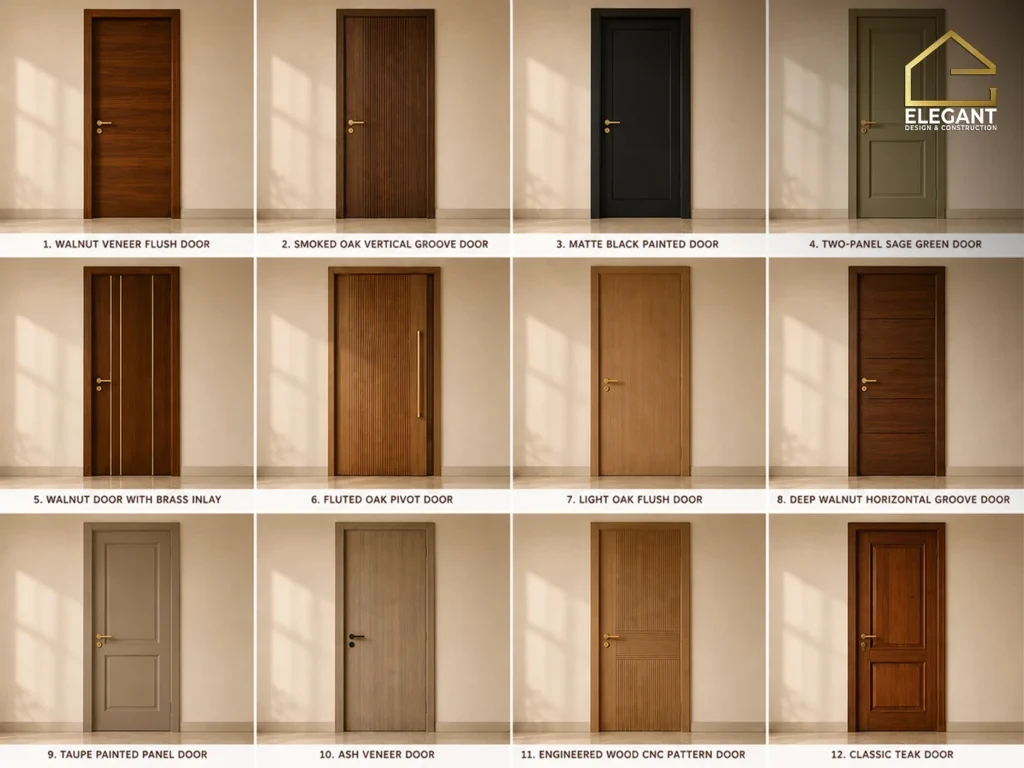
Here’s what’s actually trending for bedroom doors in Pakistani homes for 2026:
The most preferred option in new DHA and Bahria Town builds. No panels, easy to clean, floor-to-ceiling at 84–96 inches.
Color: warm walnut brown with a matte finish that shows the wood grain.
Vibe: quiet luxury, hotel suite, contemporary minimal.
The most visible trend right now, showing up in nearly every high-end project on Instagram. Shallow CNC vertical grooves, 2–3 inches deep, run the full length of a flush door with a matte black lever handle.
Color: light to medium oak in natural tone, or smoked oak for a darker look.
Vibe: modern Scandinavian meets Pakistani, no ornamentation, currently trending in Lahore and Islamabad.
Antique wood paired with a modern touch: solid-wood doors with antique or polished brass hardware, kept simple and sleek.
Colors: warm teak honey-brown or deep sheesham chocolate, antique or polished brass, cream or taupe surrounding walls.
Vibe: ideal for buyers who want “Pakistani character” without ornate carving.
A dramatic choice against cream or off-white walls. Pairs well with brushed brass or matte black hardware.
Colors: matte charcoal black with brushed brass or polished gold hardware.
Vibe: dramatic, editorial, urban apartment energy.
A clean two-panel design (larger upper panel, smaller lower panel), no carving or molding, with a brushed nickel lever handle.
Color: soft taupe, sage green, or warm beige.
Vibe: connects traditional Pakistani homes with modern interiors, family-friendly and timeless.
A walnut or teak veneer flush door with three thin vertical brass strips floor-to-ceiling, paired with a thin horizontal pull handle.
Colors: rich walnut or dark teak with rose gold or inlaid brass.
Vibe: subtle luxury, a master bedroom statement without going ornate.
An oversized single leaf, 42–48 inches, with full vertical fluting and a central pivot hinge instead of side hinges.
Color: smoked oak, dark walnut, or natural ash.
Vibe: architectural showpiece, best suited to master bedrooms with wide openings.
A vertical reeded glass insert set into a wood frame. Lets light into hallways while keeping the room private.
Colors: warm oak or walnut frame with frosted-clear fluted glass and a soft pearl tint.
Vibe: strong contemporary look.
The drawing room door is where you can be more daring. It’s the first room most guests see after entering the house.
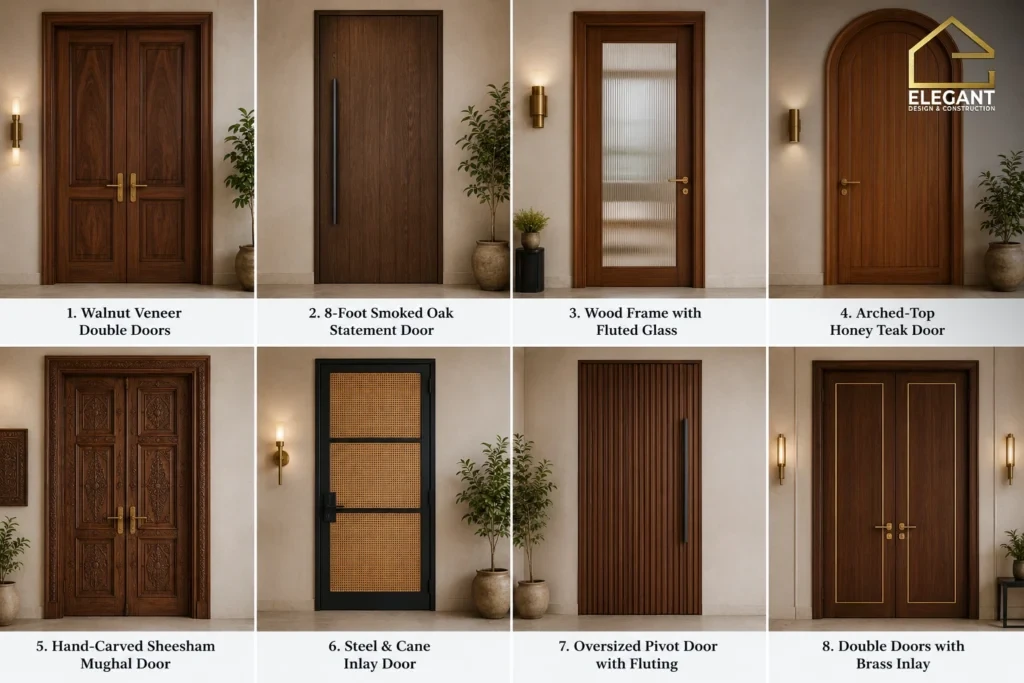
Here are the top drawing room door designs for Pakistan in 2026:
The traditional premium choice for formal drawing rooms: two matched 3-foot leaves opening to a 6-foot reveal.
Colors: rich walnut or smoked oak veneer, brushed brass or matte black hardware, warm taupe or cream surrounding walls.
Vibe: formal, grand, hotel-lobby energy in a residential setting.
An exaggerated full-height door with no panels, one bold leaf that draws the eye up and makes the ceiling feel taller.
Colors: dark walnut, smoked oak, or matte charcoal black with a thin vertical brass pull handle.
Vibe: minimalist, architectural, slightly dramatic.
A solid wood frame with vertical reeded glass inserts, letting soft light into hallways without exposing the drawing room.
Colors: warm oak or walnut frame, frosted fluted glass with a pearl tint, brushed brass or brushed nickel handle.
Vibe: modern, light, boutique hotel energy.
Curved-top double doors that reference traditional and Mediterranean architecture without going overboard. Works best in homes with high ceilings.
Colors: honey teak or warm walnut, or painted soft sage or muted terracotta with matching hardware.
Vibe: heritage and romantic, common in old Lahore havelis and modern villas alike.
Hand-carved solid teak or sheesham with traditional Mughal-style geometric or floral panels. Best sourced from craftsmen in Chiniot or Gujrat.
Colors: deep teak or honey brown with antique brass kunda handles.
Vibe: luxury, heirloom, formal, grounded Pakistani tradition.
A sleek black metal frame with cane webbing or clear/fluted glass panels. Gaining popularity in apartments in Islamabad and Lahore.
Colors: matte black frame with natural cane beige, clear glass, or optional warm oak.
Vibe: urban, industrial, design-forward.
A rotating 42–48-inch single leaf on a central-pivot hinge with full vertical fluting for texture.
Colors: smoked oak, dark walnut, or natural ash with a flush brushed-brass pull.
Vibe: five-star hotel suite, the luxury choice for wide drawing room openings.
Good hardware pays off here too. A solid brass or matte-black lever handle changes the entire feel of a drawing room door.
Pakistani homes have been gradually shifting toward semi-open kitchens. But most households still want a way to keep smoke, smell, and noise contained while cooking.
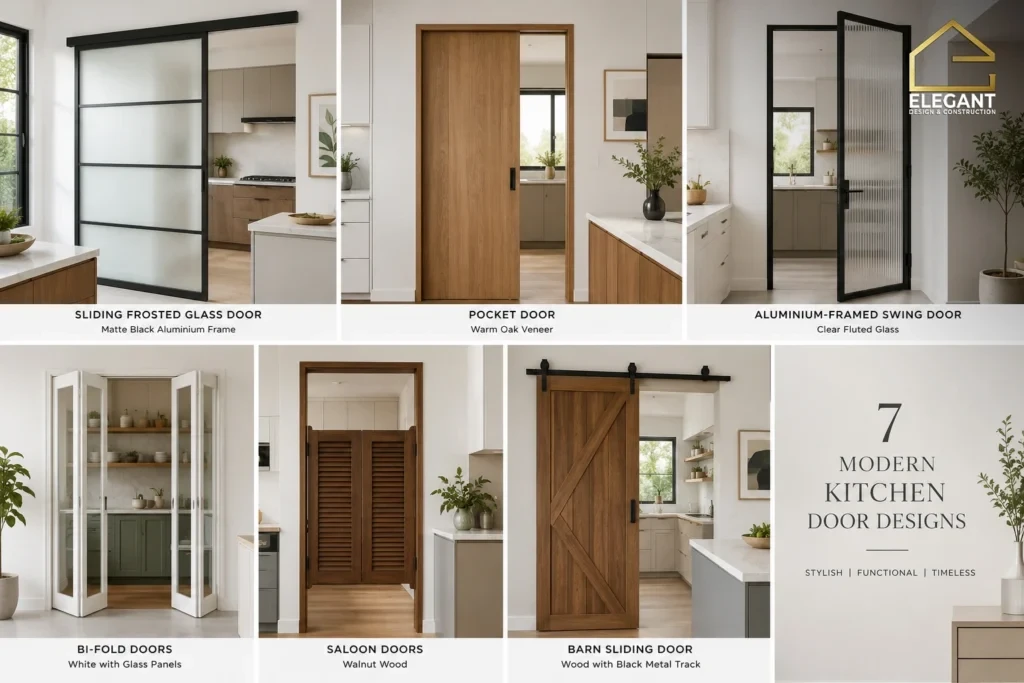
Here are the strongest kitchen doors in Islamabad and Rawalpindi used in residential homes:
Single or double sliding glass panels that tuck away when open and close to block cooking steam and odor, go-to choice for semi-open kitchens.
Colors: frosted white-pearl glass with a slim matte black or brushed aluminum frame, optional warm oak floor track.
Vibe: fresh, modern, semi-open, welcoming.
The door slides fully into a wall cavity when open, so it takes up no floor footprint. Ideal for small kitchens where a swinging door would eat into counter space.
Colors: warm oak or walnut veneer, or painted matte white for minimal kitchens.
Vibe: space-smart, practical, well suited to apartments and small homes.
A clear or frosted glass panel in a light, slim aluminum frame. Affordable, easy to clean, and durable against kitchen splashes.
Colors: matte black or champagne-gold frame with clear or fluted glass.
Vibe: modern and practical, a genuinely budget-friendly option.
Multiple panels that fold back accordion-style against the wall, giving you a fully open layout when entertaining and a closed kitchen when cooking something heavy.
Colors: white painted wood with clear glass panels, or a natural oak frame with frosted glass.
Vibe: flexible, entertainer-friendly, common in modern villas.
Short doors that swing both ways, useful for carrying trays in and out without stopping to push a handle. A newer trend in Pakistani kitchens.
Colors: warm oak or walnut wood with brass or matte black push plates.
Vibe: informal, functional, bistro-style.
A reeded vertical glass insert in a solid wood frame, letting light through between the kitchen and dining space while softening the direct view of the cooking area.
Colors: warm oak or walnut frame, frosted fluted glass with a pearl tint, brushed brass or brushed nickel handle.
Vibe: contemporary, boutique-kitchen feel.
A wooden door mounted on an exposed black metal track that glides along the wall. An industrial-modern style moving from drawing rooms into kitchens.
Colors: smoked oak or dark walnut door, matte black track and handle.
Vibe: farmhouse kitchens, design-forward modern villas.
Avoid solid wood for a kitchen door near an oil-frying station. Heat and oil will change the finish over time. Use glass or composite door handles that withstand exposure better.
If your kitchen door decision is tied to a broader kitchen refresh, it’s worth reviewing kitchen cabinet designs, since doors and cabinetry usually share a finish.
For a bathroom, the material matters more than the design. A beautiful wooden door in a high-moisture bathroom will warp within 18 months unless it’s properly sealed and ventilated.
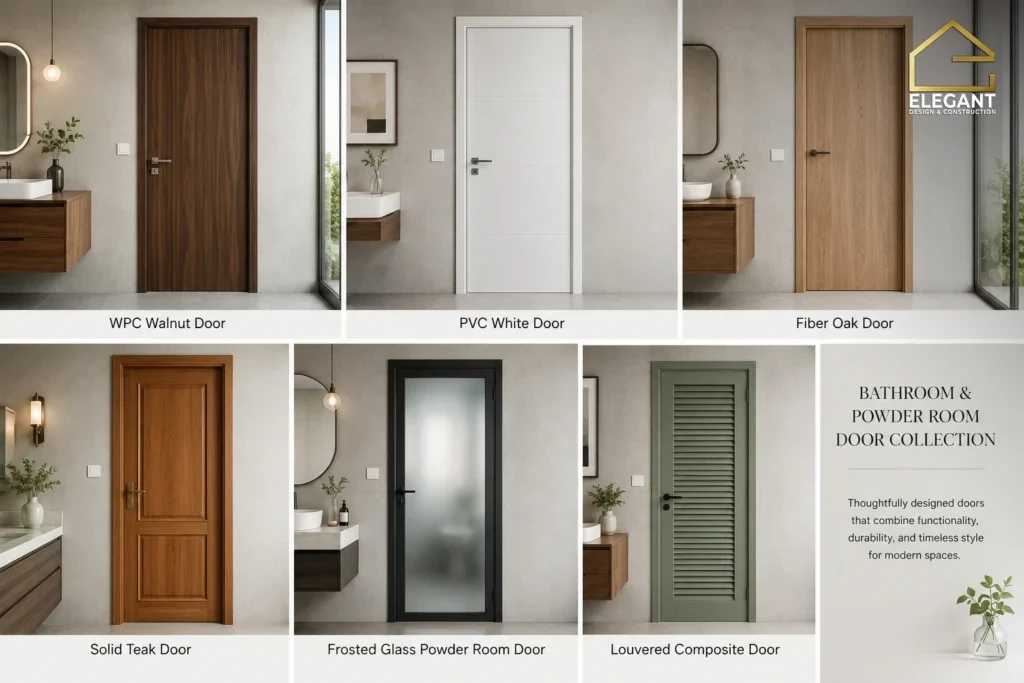
Here are the top bathroom door designs for Pakistan in 2026:
A fully waterproof composite door with an authentic wood grain look. It’s become a standard choice in new Pakistani construction: looks like wood, behaves like plastic.
Finishes: walnut, teak-grain, or matte white with a brushed nickel or matte-black handle.
Vibe: modern, practical, low-maintenance.
Fully waterproof, lightweight, and the cheapest option on this list. Laminate wood-grain finishes work well for budget projects.
Colors: cream, off-white, or light oak-grain with a simple chrome or aluminum handle.
Vibe: budget-friendly, clean, minimalist.
A durable laminate-core fiber door: better looking than PVC, cheaper than solid wood, and tolerant of humidity.
Color: warm oak, walnut, or matte white laminate with a brushed nickel or matte black handle.
Vibe: modern, practical, a solid choice for a family bathroom.
A solid wood door sealed with marine-grade polyurethane to withstand bathroom moisture. It looks great, but it needs recoating every 3–4 years and good ventilation.
Colors: rich teak honey-brown, dark walnut, or smoked oak with brushed or antique brass handles.
Vibe: luxury master bathroom, hotel-suite quality.
A slim aluminum frame holding a fully frosted glass panel. Modern and light, best for powder rooms specifically, since full bathrooms need more privacy than frosted glass gives.
Colors: matte black, champagne gold, or brushed silver frame with frosted white-pearl glass.
Vibe: contemporary, powder-room chic.
A vertical reeded glass panel in a thin aluminum frame. It distorts the view less than fully frosted glass, but still allows some light through.
Colors: matte black or warm brass frame with fluted clear-pearl glass.
Vibe: on-trend, a strong statement piece for a powder room.
A ventilated composite or wood door with horizontal louvred slats. This solves the trapped-humidity problem that destroys most bathroom doors.
Colors: matte white, light oak-grain, or painted soft grey with a simple lever handle.
Vibe: practical and well suited to high-humidity cities.
Rule for every bathroom door: Leave a 12mm gap at the bottom for ventilation, or use a louvred vent. Trapped humidity kills more doors than direct water exposure ever does.
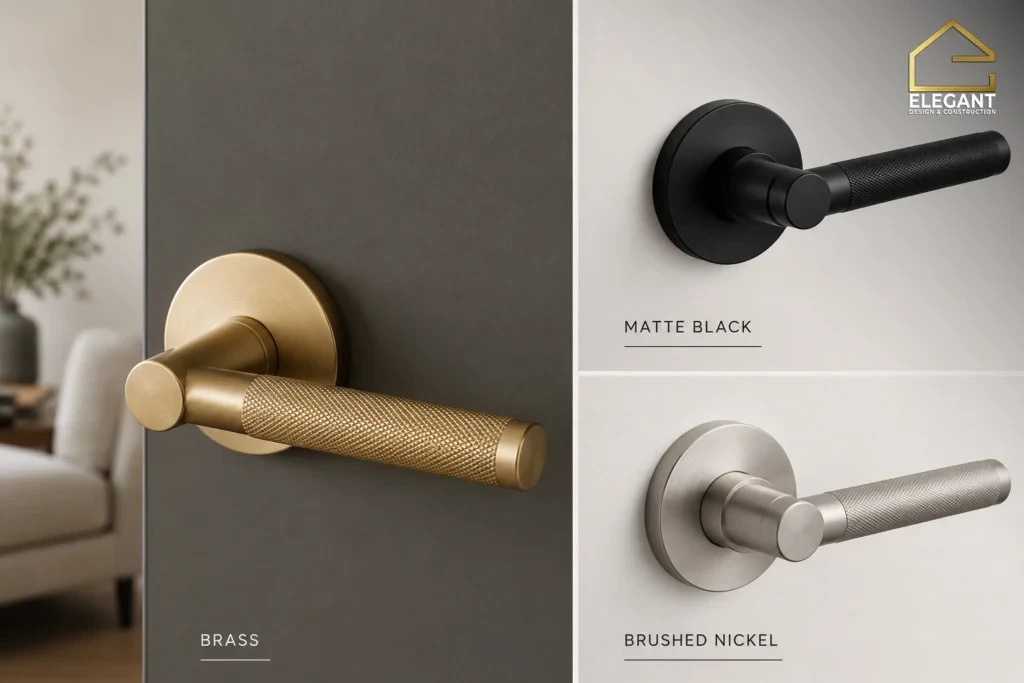
Good door, bad hardware, and the whole thing falls flat. The handle is the part every guest actually touches, so it needs to feel solid.
Match your hardware finish across the whole house. Mixing brass, chrome, and black randomly from door to door looks unplanned.
Standard door sizes in Pakistan aren’t fully standardized. They vary by city and builder, but these are the typical ranges:
| Door Type | Width | Height |
|---|---|---|
| Main entrance | 48–60 inches | 84–96 inches |
| Drawing room (double door) | 60–72 inches | 84–96 inches |
| Bedroom | 36–42 inches | 80–84 inches |
| Bathroom/wash | 26–30 inches | 78–80 inches |
| Kitchen | 32–36 inches | 80–84 inches |
| Store/utility | 24–28 inches | 78–80 inches |
For modern interiors, size up on height. An 84-inch door in an 11-foot ceiling room looks stunted. A 96-inch door looks intentional. The extra cost at the construction stage is small, and it’s essentially impossible to fix later.
For deeper guidance on coordinating doors with the rest of your interior, explore our interior design services, where door selection is treated as a core decision from day one.
A short list of mistakes we see across homes in Lahore, Rawalpindi, and Islamabad:
A great door still looks wrong if it fights the rest of the interior. Quick guidance by style:
Doors and accent walls are usually chosen around the same time, since both set the tone for a room’s overall style. Settle on your door style early, before tiles, paint, and curtains. Doors are the hardest element to change once construction is finished, and your choice of finishing materials will affect both price and how well they hold up over time.
Ready to plan doors for a complete interior project? Our team at Elegant Design & Construction designs, sources, and installs custom doors across Pakistan as part of full interior packages. Get in touch with our team for an interior design consultation to get ideas on the rest of your home.
Engineered-wood flush doors with walnut or oak veneer, in full-height configurations 84–96 inches, are the dominant choice in new urban construction. Vertical groove patterns and matte black-painted doors are the strongest emerging trends.
Composite, WPC, and PVC doors handle humidity best; they resist warping and termites even with constant moisture exposure. Solid wood can work in a bathroom if it’s sealed with a marine-grade polyurethane finish and the room has a ventilation gap at the bottom, but composite is the lower-maintenance choice for most households.
Yes, and it often creates a more cohesive interior. Use one base design with size and finish variations by room. Our [interior designers](/interior-design-services-islamabad-rawalpindi/) can create a custom plan based on whatever base design you choose.
A solid- or engineered-wood door with proper finishing and reasonable care lasts 25–40 years. Cheap hollow doors typically need replacing within 5–7 years. Hardware like hinges and locks usually needs replacing once or twice over the door’s lifespan.
Four-inch ball-bearing hinges (three per door), a mortise lock, and a lever-style handle in a finish that matches your interior. Brushed brass, matte black, and brushed nickel are the current favorites. Add a door stop, and consider a soft-close damper for bedroom and bathroom doors.